
Maharashtra has the opportunity to solve all these problems by voting for the Congress and NCP, he said.

Weather forecasts have notoriously large error margins.

'It is less polarising than Hindutva.'
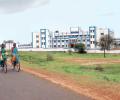
Lalgarh, once a nerve centre of Naxal insurgency in West Bengal, now represents a different place.
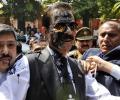
India does not have a unified regulatory regime to counter Ponzi, or pyramid, schemes whose operators typically grab new deposits to meet their promise of guaranteed returns to existing savers, point out Manoj Kumar and Mayank Bhardwaj.

The middle class is a big force to fulfil dreams of a prosperous and developed India and our government has taken many decisions to empower it, the prime minister said.
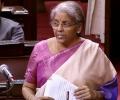
She said that despite government scheme and initiatives ranging from roads to agriculture, housing, scholarships to electricity benefiting lives of people, a false narrative was being created by the opposition that the government was working for cronies.
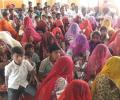
'There is no money with the villagers as there is little work.'
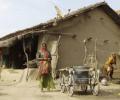
The centre pays only an insulting Rs 200 per pensioner each month at a tight-fisted 0.04 per cent of GDP, among the lowest in the world. Instead, as illustrated by Jean Drze, one option is for NYAY to provide individual rather than household entitlements to all pensioners of at least Rs 1200 per month.

The loss in Bihar has forced a change in NDA's market positioning, says Shekhar Gupta.

'The Indian economy has been subsidised by the poor.'
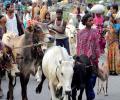
India is experiencing jobless growth and skepticism abounding that the country may not be able to cash in on its demographic bonus

Prime Minister Narendra Modi's idea of cooperative federalism is expected to be on display in the 2015-16 Budget.

Congress vice president says people now laugh at Modi's promise of 'achche din'.

If the corruption issue doesn't claim Mr Baghel, the Congress's chances in the assembly election later this year are good, observes Aditi Phadnis.

Leader of Opposition Mallikarjun Kharge, speaking on the Motion of Thanks on the President's address, charged the government with not delivering on its various promises, including generating two crore jobs per year.

Kanika Datta explains why the Modi sarkar is gunning for non-profit organisations

While no specific state-oriented sops were rolled out, a strong thread of political wellness ran through the Budget.
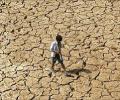
The Budget has stuck to annual increases in agri credit targets.

One solution to India's challenges of education, employment, employability lies in state governments adopting apprenticeships on a large scale.
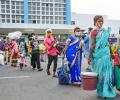
Around 275,000 migrant labourers and their family members have returned to the state. According to the state government, this number could exceed 1 million by the end of this month. As the NDA government in Bihar is scheduled to face polls at the end of this year, providing livelihoods to these people is on the top Chief Minister Nitish Kumar's agenda.

Politically, it will not be easy for Modi to take hard decisions such as raising fuel prices in the first budget, given the risk of higher inflation.
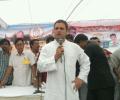
In two and a half years, first PM-like action by Modi: Rahul Gandhi on India's surgical strikes

Finance Minister Arun Jaitley presented the Union Budget.

A programme that endeavours to graduate the poorest people could have seminal implications for Prime Minister Narendra Modi's government.

India must do away with policy paralysis to ensure growth in agriculture.

'The current economic contraction is certainly due to the lockdowns as a response to the pandemic, which is an act of God.' 'Nobody has seen such a thing in the last 100 years.' 'Saying that this was an act of mismanagement is largely incorrect'

Chief Economic Advisor Arvind Subramanian's interview.
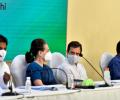
'Fixing accountability in the Congress must be addressed on a war footing.' 'It is impossible for Sonia Gandhi to know each and every party worker, so she has to rely on advisors.' 'If they guide or misguide, the blame should go to them.'

Stating that pushing GDP growth, which has slipped to 5-year low of 6.8 per cent in 2018-19, is the top priority, President Ramnath Kovind said Modi govt will bring more reforms and raise farm investments to boost growth.

'The current crisis is one of incomes, driven by poor job growth, agrarian distress and poor investment sentiment,' notes Harsh Pati Singhania, director, JK Organisation.
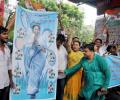
Political economist Jayanta Roy Chowdhury analyses the 2016 West Bengal assembly election results.
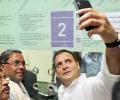
The IIM-B's 'Karnataka innovation report' has become the basis for the Congress party's election narrative, particularly to distinguish it from the 'Gujarat model of development', reports Archis Mohan.

At a time when major economies have increased spending, India will have to do the same.

When KV Thomas took over as minister of state for food and consumer affairs (independent charge) on January 19, 2011, he was tasked with taking forward one single, important objective: expedite the implementation of the National Food Security Bill.

Here's the full text of President's Ram Nath Kovind's address to the joint sitting of both houses of Parliament on the first of Budget Session 2022.

In a video issued by the Health Ministry, Dr Randeep Guleria, Director of the All India Institute of Medical Sciences (AIIMS) answered commonly asked questions regarding the dosage of the vaccine saying that two doses of the vaccine will have to be taken 28 days apart and protective levels of antibodies generally would develop two weeks after the second dose.

Rahul Gandhi slammed the Modi government, accusing it of being against farmers, labourers, students and the poor.

Noting that oil prices had gone down after the BJP-led government came to power in May 2014, before they went up, Prasad said it is a problem whose solution is not in its hands.

Lunch with BS: Sukhbir Singh Badal, deputy chief minister, Punjab
 © 2026 Rediff.com - Advertise with us - Disclaimer - Privacy Policy - Sitemap - Feedback - About us - Terms of use - Grievances